
 Visitor Registration
 Visitor My Page
Outline
| Exhibition Name | WELL-BEING TECHNOLOGY |
|---|---|
| Date | Wednesday, December 16 - Friday, December 18, 2026 10:00-17:00 |
| Site | Tokyo Big Sight West and South Halls |
| organizing | WELL-BEING TECHNOLOGY Executive Committee
|
| Chief Ambassador |
|
| Supported by | Society of Well-being Robot Friendly Asset Promotion Association Consortium for Applied Neuroscience |
| Concurrent Exhibitions |
|
| Number of visitors | 47,000 (planned) |




Features
Focusing on creating industries that create an environment of "well-being"
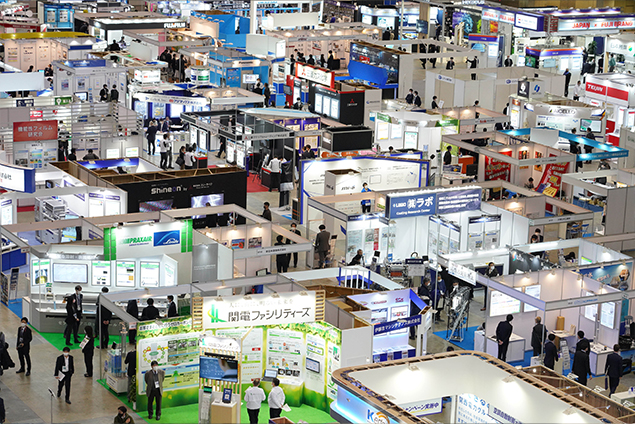
This is an exhibition of products and services that contribute to "well-being," a concept attracting increasing attention at a time when people's consumption behavior, work styles, and values are diversifying. From the viewpoints of science, including engineering and chemistry, technologies for realizing a well-being environment will be gathered.
A place for Business Co-creation and Communication across Different Industries and Professions
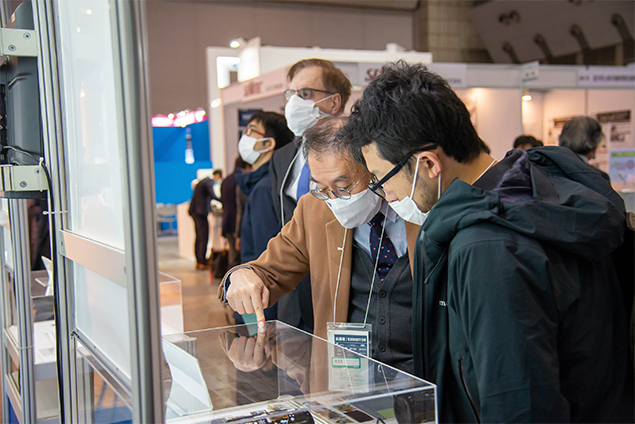
To realize a well-being society—a goal that cannot be measured by a single index—co-creation among diverse players across industries and professions is essential. This exhibition focuses on the "creation of environments" for well-being. We provide a platform for collaboration and communication for those involved in business development, product development, and design across a wide spectrum of fields, including materials, space design, sensing technology, and robotics. Our goal is to foster meaningful "encounters" with new people, organizations, and technologies.
Exhibition Theme


A Better Society through Materials and ICT
We define well-being as "living in comfort and abundance." Since the conditions for well-being cannot be captured by a single indicator, they must be achieved through the interplay of various factors. Consequently, there is growing anticipation for new products and services emerging from co-creation among diverse players across industry boundaries, as well as for the technologies that bring them to life. Focusing on "environment creation" for well-being, this exhibition serves as a collaborative hub where product and service developers from various fields—ranging from materials and space design to sensing technology and robotics—gather to contribute to the realization of a well-being society.
Why You Should be Developing Well-Being Products and Services
Sustainable environmental considerations (SDGs) have become an essential part of product and service development. Furthermore, in recent years, there has been an increased global focus on the well-being of the human body and mind. In fact, in the area of work styles and human capital, it has been shown that along with a well-being work environment, it is also associated with higher productivity and lower turnover.
In addition, the development of products and services focused on "well-being" and the development of technologies may enhance our sustainability as a company in the following ways
- New Market Development
- Leading new markets through innovation that creates new social value and gaining competitiveness as an advanced company
- relationship building
- Building a strong brand and human resource acquisition for user segments that support the values (especially younger generations, especially Generation Z)
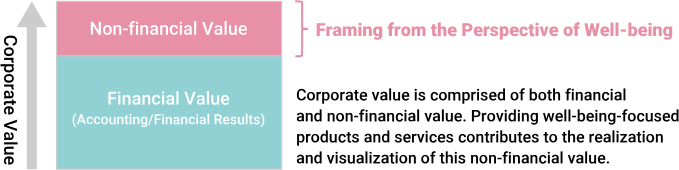
- Nonfinancial Value*.
- Providing clear differentiation (risk management) of ESG factors (especially "Social") for investors and shareholders, which impact on stock price
- *Non-financial value
- Values that a company possesses that are not directly listed as numbers in the financial statements that contribute to future profit generation, such as human capital initiatives and corporate brands that are linked to solving social issues.
Examples of Products and Services That Contribute to Well-Being
In order to create products and services that contribute to well-being, it is necessary to consider the factors that contribute to it. Well-being is a combination of the words "well" and "being," and is a concept that describes a state where an individual lives a life of vitality and comfort. The conditions and triggers necessary for this are called factors. Of course, what factors contribute to a person's well-being differs from person to person. Junji Watanabe, the chairperson of the exhibition's executive committee, classifies the factors of well-being into four categories: "I," "We," "Society," and : “Universe.” “I ” is the factor of the individual; "We" is the factor of the relationship with a specific other; "Society" is the factor of the relationship with a wider society that includes many unspecified others; and "Universe" is the factor with a perspective that includes everything that transcends these factors (Image 1). [Image 1
- Image 1
-
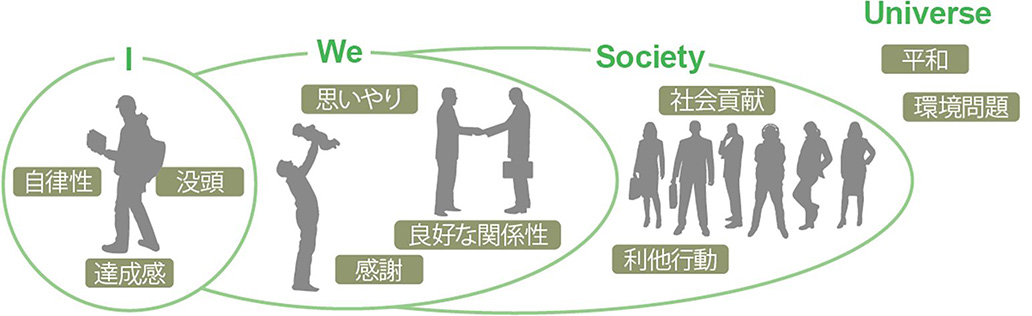
Source: "FURUE," a magazine specializing in wellbeing + tactile contents from NTT Laboratories, Vol. 31
Based on this concept, NTT Laboratories created the "Our Well-Being Card" (supervised by Junji Watanabe, produced by Nippon Telegraph and Telephone Corporation, 2024) as a tool to raise awareness and encourage dialogue about the well-being of ourselves and those around us (Image 2). The card contains factors for each category: "I" (enthusiasm, immersion, challenge, etc.), "We" (close relationships, trust, etc.), "Society" (compassion, diversity, etc.), and "Universe" (connection to life, karma, etc.). [Image 2
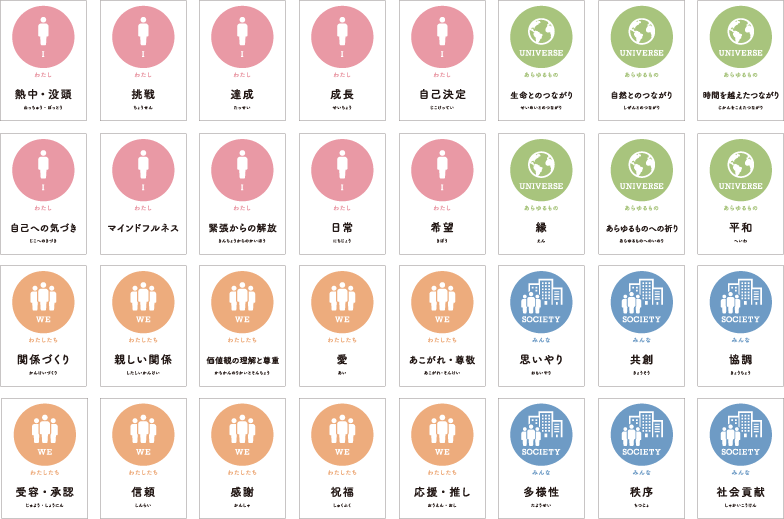
Organized according to these ideas, examples of products and services that contribute to wellbeing are listed below for reference.
Example 1: Material
Factors contributing to general sustained wellbeing
I
Relief from Tension
Pleasant-to-the-touch fabrics that make you feel calm.
Enthusiasm and Immersion
A chair that supports posture and does not feel restrictive.
Awareness of Self
Space that stimulates the five senses according to the individual's physical and mental state of mind.
We
Intimate Relationship
Clothing that retains body heat and allows you to feel the warmth of those close to you, even when you are far away.
Love
Fabrics that give the robot the feel of a living organism
Support and Promotion
Materials that give a sense of story and context that express support and celebration for those close to you.
Society
Diversity
Packaging that is easy for everyone to open, from children to seniors.
Joint Creation
Database of a wide variety of materials with various functions and characteristics that trigger co-creation with others.
Universe
Connection with Nature
Office space with a sense of connection to nature using local resources.
Connection to Life
Products made from materials that allow you to feel the presence of life.
Example 2: Sensing
Factors contributing to general sustained wellbeing
I
Awareness of Self
An application that allows you to visualize your status as it changes from situation to situation.
Relief from Tension
A space that automatically adjusts lighting and sound to the most relaxing state for the individual based on brain waves.
We
Building Relationships
A device that reproduces the movements to enable a closer relationship.
Acceptance and Approval
Sensors that monitor sleep and waste elimination to reduce the burden of home nursing and caregiving.
Society
Diversity
Prosthetic limbs that can be controlled like one's own body by myoelectricity and line of sight.
Contribution to Society
A system that detects your smiles and enables donations based on the number of times you have smiled.
Universe
Connection with Nature
A system that allows you to track where the products you use come from and where they return to.
Connection to Life
A device that allows you to hear your baby's heartbeat and share your own with them.
Example 3: Robotics
Factors contributing to general sustained wellbeing
I
Awareness of Self
A robot that assesses mental health status and enables remote consultations depending on the situation.
Relief from Tension
Robot that wraps you up like a hug.
Everyday
A partner robot that guides your daily activities and supports you in your daily life.
We
Love
Robots that make you want to take care of them to facilitate better family relationships.
Intimate Relationship
Robots that can sense each other's presence from a distance.
Collaborative robots that work together with humans to reduce workload.
Society
Diversity
Remote control technology to increase work options even with physical and time constraints.
Order
Automatic driving technology to assist human movement and achieve safe, secure mobility.
Universe
Peace
Robots that ease human conflict and aid constructive discussion by being present.
Example 4: VR
Factors contributing to general sustained wellbeing
I
Enthusiasm and Immersion
High-resolution images and multi-sensory experiences that enhance immersion and provide a more realistic gaming experience.
Achievement
Simulated medical surgeries, evacuation drills, etc. to improve the ability to replicate and respond to real-life situations.
We
Longing/ Respect
Virtually experience traveling to the World Heritage sites you've always wanted to visit.
Building Relationships
Enjoy conversations and collaborative activities in a virtual space with people you have never met.
Trust
Employees can feel each other's presence at work, whether they are at the company or not.
Society
Diversity
Avatar robot technology allows people with physical and time constraints to have a variety of career options.
Universe
Connection with Nature
Experience the great outdoors, the ocean, and outer space from the comfort of your own home.